Measure for Measure: Britain's Magnificent Refusal to Buy Things That Actually Fit
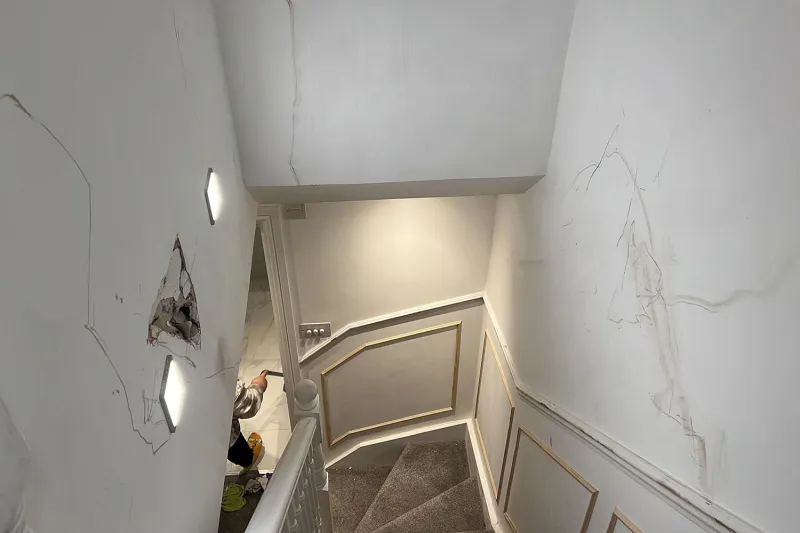
Photo: sofa stuck staircase moving house British home delivery, via people.com
Measure for Measure: Britain's Magnificent Refusal to Buy Things That Actually Fit
There is a sofa on a staircase in Peckham. It has been there for three days. The removal men left after the second day, having exhausted both their vocabulary and their goodwill. The sofa is 220cm long. The stairwell, at its narrowest point, is 198cm diagonally. The owner measured the room. The owner measured the sofa. The owner did not, at any point, measure the stairwell — because measuring the stairwell would have introduced information that might have prevented the purchase, and the sofa was perfect.
This is not an isolated incident. This is Britain.
The Optimism of Purchase
At the precise moment of buying something, a very specific and well-documented cognitive phenomenon occurs. Psychologists call it 'optimism bias.' Retailers call it Tuesday. The rest of us experience it as the absolute, bone-deep certainty that the thing we are about to buy will fit — the room, the body, the life, the staircase — despite all available evidence suggesting otherwise.
Britain's relationship with size and fit is one of the most expensive national delusions in consumer history. The Office for National Statistics estimates that returns related to sizing — across furniture, clothing, and homewares — cost British retailers and consumers a combined £4.7 billion annually. That's not the cost of things that are the wrong size. That's just the cost of the administration of things that are the wrong size. The things that are kept, wedged, altered, or simply lived with in silent disappointment are an entirely different line item.
We are, as a nation, remarkably bad at buying things that fit us. We are also, and this is the crucial part, not particularly bothered about it.
The Aspirational Size
Clothing retail has built an entire economic model on the gap between the body a person has and the body a person expects to have by the time they wear the thing they're buying. The aspirational size — the jeans purchased in a 32 that the buyer was last wearing in 2017, the dress bought in a 12 'for that wedding in June,' the suit jacket that fits across the shoulders but requires a very specific posture to button — is not a mistake. It is an act of extraordinary optimism.
Fashion retailers understand this with crystalline clarity. The placement of size labels, the generous cut of certain lines, the strategic use of 'relaxed fit' (which means, in practice, 'we've made this bigger so you can pretend you're not'), the lighting in changing rooms — all of it is calibrated to support the fiction that the thing fits, or will fit, or would fit under slightly different circumstances that are entirely achievable.
The rise of online clothing retail has, counterintuitively, made this worse. Without a changing room to interrupt the fantasy, British shoppers buy with pure imagination. Returns rates for online clothing sit at around 30% in the UK — one of the highest in Europe — and the majority cite 'sizing issues.' But the proportion of those items that are returned versus kept, unworn, in a wardrobe 'until they fit' is a number no one in the industry is particularly keen to publish.
The Tape Measure Problem
Here is a thing that furniture retailers know, and that they would very much prefer you didn't think too hard about: the tools they provide for measuring are designed to be just helpful enough to prevent total disaster, and not quite helpful enough to prevent the sale.
The room planner on the IKEA website is a masterpiece of strategic imprecision. It will tell you whether a sofa fits a room in the abstract. It will not, without considerable user initiative, tell you whether the sofa fits through the door of the room, around the bend in the hallway, or up the specific geometry of your Victorian terrace staircase. This is not a design flaw. This is a design feature.
Same-day delivery has accelerated the problem considerably. When a sofa can arrive before the doubt does, the window for practical consideration closes entirely. The purchase is made. The dopamine hits. The tape measure is found, too late, in a kitchen drawer.
The 'It'll Do' Doctrine
Where Britain truly distinguishes itself from other consumer nations is not in the buying of wrong-sized things — that's a universal human failure — but in the keeping of them. The 'it'll do' doctrine is a cornerstone of British domestic life, a philosophy of pragmatic acceptance that allows us to live, indefinitely, with things that are slightly, persistently, unmistakably off.
The curtains that are two inches too short, so they don't quite reach the sill. The fitted sheet that technically fits the mattress but requires a structural engineering approach every time you change the bed. The kitchen table that seats four 'comfortably' and six 'if no one needs to use their elbows.' The bath mat that's slightly too wide for the space between the bath and the toilet, so it curls up at one edge and becomes a minor daily hazard.
All of these things were bought knowing, on some level, that they weren't quite right. All of them are still there. None of them will be replaced until they physically disintegrate, because replacing them would require acknowledging that the original purchase was imperfect, and that acknowledgement is, for reasons that are more emotional than rational, simply not on the table.
The Body That's Coming
The clothing version of this phenomenon has a particular poignancy that furniture can't quite match. A sofa in the wrong size is an inconvenience. A dress in the wrong size is a whole relationship — with the body you have, the body you're planning to have, and the gap between the two that retail has learned to inhabit with extraordinary commercial effectiveness.
The wellness industry and the fashion industry have, perhaps not coincidentally, developed a deeply symbiotic relationship around this gap. The dress bought in an aspirational size creates the motivation for the gym membership. The gym membership creates the optimism for more aspirational sizing. The cycle continues, with both industries profiting from the distance between where a person is and where they'd like to be.
It is, from a certain angle, a very elegant system.
The Measurement We Refuse to Take
The single most effective thing a British consumer could do to save money would be to measure things accurately before buying them. Measure the stairwell. Measure the body as it currently exists, not as it existed in a more flattering decade. Measure the window before ordering the curtains. Measure the gap between the bath and the toilet before buying the bath mat.
This does not happen. It does not happen because measuring introduces precision into a process that runs, at its core, on imagination. And imagination — the sofa in the perfect room, the dress on the aspirational body, the dining table at the dinner party that hasn't happened yet — is what shopping is actually selling.
The wrong size is not a bug in the British consumer experience. It is a feature. It is the gap between desire and reality made tangible, purchased, delivered, and wedged at a forty-five degree angle in a stairwell in Peckham.
It's fine. It'll fit eventually.
It won't fit eventually.