The Theatre of Domestic Perfection
In homes across Britain, there exists a parallel universe of possessions—items bought not for daily use, but for the theoretical moment when someone might notice them. The good china that emerges twice a year. The expensive hand soap in the downstairs loo that's too nice for actual hand-washing. The coffee table books arranged with the precision of a museum display, spine-out and dust-free, waiting for visitors who exist more in imagination than reality.
Welcome to Britain's most expensive performance: the elaborate staging of a life that looks, from the outside, perfectly curated. It's method acting for the middle class, and it's costing us billions.
The Anthropology of Aspirational Objects
Every British home contains what anthropologists might call "display objects"—items whose primary function is to communicate something about their owner's taste, success, or sophistication. These aren't tools for living; they're props for a play called "Look How Well I'm Doing."
The guest towel is perhaps the perfect example. Soft, expensive, often monogrammed, it hangs in the guest bathroom like a textile museum piece. Its purpose isn't absorption—it's aspiration. It says: "I am the type of person who owns towels specifically for other people's hands." The fact that those other people rarely materialise is beside the point.
Consider the modern British kitchen, where a £400 coffee machine sits gleaming on the worktop, used perhaps six times a year when "having people over for dinner." The rest of the time, it's an expensive sculpture that communicates sophistication to anyone who might glance through the window. Its daily coffee-making duties are handled by a humble cafetière hidden in a cupboard.
The Dinner Party Industrial Complex
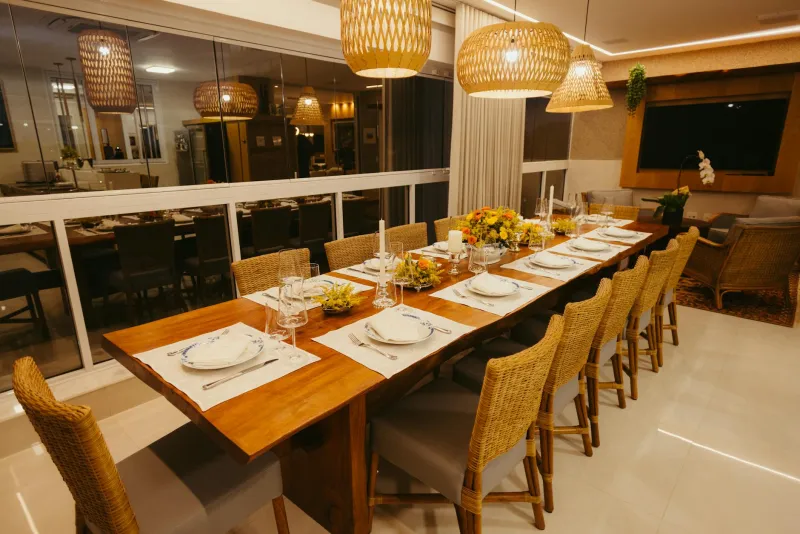
Britain's ghost guest economy reaches its peak in the dinner party preparation industry. Entire retail categories exist solely to service events that happen less frequently than solar eclipses. The cheese board that cost more than most people's weekly shop. The wine glasses so delicate they require their own insurance policy. The serving dishes that see action roughly as often as Halley's Comet.
 Photo: Halley's Comet, via www.universeguide.com
We've created an entire shadow economy around the theoretical dinner party—that mythical gathering where our carefully curated possessions will finally have their moment to shine. The irony is exquisite: we buy things to impress people we rarely invite, for events we seldom host, in service of an image of ourselves that exists primarily in our own minds.
The dinner party has become Britain's most expensive form of creative writing—a fiction we furnish with props we'll probably never use.
The Psychology of Preemptive Hospitality
There's something deeply British about buying items "just in case" someone visits. It's hospitality as anxiety management, a way of preparing for social scenarios that may never occur. The extra bedding set for overnight guests who haven't stayed since 2019. The good biscuits hidden behind the everyday ones, waiting for visitors worthy of proper refreshments.
This preemptive hospitality shopping serves a psychological function beyond mere preparation. It's a way of maintaining the fiction that we're the type of people who regularly entertain, who have rich social lives filled with spontaneous gatherings and impromptu dinner parties. The objects become evidence of a lifestyle we aspire to rather than one we actually live.
The guest bedroom is perhaps the most expensive expression of this phenomenon—an entire room furnished for theoretical occupants, decorated with the care of a boutique hotel and used with roughly the same frequency as a nuclear bunker.
The Curation Generation
Social media has supercharged our appetite for ghost guest shopping. Instagram has turned every home into a potential photoshoot location, where every surface must be "camera-ready" for the possibility of unexpected documentation. We buy objects not just for hypothetical guests, but for hypothetical content.
The bookshelf has become a particularly revealing example. Once a storage solution for things we actually read, it's now a carefully curated display of intellectual aspirations. The books are chosen not for reading but for their spine appeal—their ability to communicate sophistication to anyone who might glimpse them in the background of a video call.
We've become curators of our own lives, and curators need objects to arrange.
The Economics of Imaginary Audiences
The ghost guest economy represents one of retail's most successful psychological manipulations: convincing people to buy things for audiences that don't exist. Homeware retailers have mastered the art of selling not just objects, but the fantasy of the life those objects might enable.
That £200 serving platter isn't just a dish—it's the promise of elegant dinner parties filled with witty conversation and perfectly plated food. The expensive candles aren't just wax and wick—they're the ambiance for sophisticated evenings that exist primarily in our imagination.
The tragedy—or perhaps the beauty—of this economy is that the fantasy often proves more satisfying than reality. The anticipation of the perfect dinner party, the planning of the ideal guest experience, the careful arrangement of objects that might never be properly appreciated—these activities provide genuine pleasure, even if the events they're preparing for never occur.
The Liberation of Unused Objects
Perhaps there's something profound about owning beautiful things that serve no practical purpose. In a world increasingly focused on utility and efficiency, the ghost guest purchase represents a small rebellion against purely functional living. It's an investment in possibility, a hedge against future social opportunities.
The unused serving dish becomes a daily reminder of our capacity for hospitality. The pristine guest towels are evidence of our consideration for others. The carefully arranged books represent our intellectual curiosity, regardless of whether anyone ever notices them.
In this light, ghost guest shopping isn't delusion—it's aspiration made tangible. We're not buying objects; we're buying the promise of becoming the type of people who would use those objects.
The Art of Theoretical Living
Ultimately, Britain's ghost guest economy reveals something beautiful about our relationship with objects and aspiration. We're willing to spend billions on the possibility of hospitality, on the chance that someone might notice our good taste, on the hope that our lives might occasionally live up to our carefully curated environments.
It's expensive, it's slightly absurd, and it's thoroughly, wonderfully British. We've turned shopping into performance art, and our homes into galleries of theoretical living.
And perhaps that's not such a bad thing. After all, the most interesting people have always been those who live as if someone fascinating might arrive at any moment—even if they never do.