The Great British Bargain Delusion
Somewhere in the collective British psyche, a peculiar form of arithmetic has taken root. It goes like this: if something costs £100 but you pay £60, you haven't spent £60—you've saved £40. Never mind that you didn't need the item in the first place, or that you wouldn't have paid £100 for it anyway. The discount has transformed a purchase into a victory, spending into saving, and impulse buying into financial genius.
Welcome to the wonderland of British bargain logic, where the size of the reduction matters more than the size of the expenditure, and where "70% off" can make a £200 mistake feel like a £140 triumph.
The Mathematics of Madness
The British relationship with discounts operates on a parallel mathematical system that would make economists weep and accountants reach for the gin. In this alternative universe, money saved is money earned, regardless of whether it was money you intended to spend in the first place.
Consider the typical British response to a sale:
- Original price: £80
- Sale price: £32
- British brain calculation: "I've just made £48!"
- Actual bank balance: £32 poorer
- Emotional state: Smugly victorious
This isn't simple self-deception—it's a sophisticated psychological framework that allows us to feel financially responsible while behaving financially irresponsible. We've gamified spending money, turning every purchase into a potential win against the retail system.
The Cultural Roots of Reduction Obsession
Britain's bargain obsession didn't emerge in a vacuum. Our love affair with a good deal traces back through centuries of market culture, wartime rationing, and a deep-seated belief that paying full price is somehow admitting defeat. From the haggling traditions of East End markets to the modern-day stampede of Black Friday, we've elevated bargain hunting from necessity to national sport.
The language we use reveals everything. We don't "buy things on sale"—we "snap up bargains," "grab deals," and "bag steals." The vocabulary of violence and victory transforms shopping from a mundane transaction into a battle we're determined to win, even if victory means owning things we don't particularly want at prices we can't really afford.
The Clearance Aisle Psychology
Step into any British shop's clearance section and witness a masterclass in consumer psychology. Here, surrounded by the retail equivalent of orphaned puppies, shoppers exhibit behaviour that would be considered irrational in any other context.
The clearance aisle operates on its own ecosystem of desire. Items that were completely ignorable at full price become irresistible at 60% off. That lime green jumper nobody wanted in March becomes a "must-have" in the July sale, despite the fact that it's still lime green and still July.
"I couldn't leave it there at that price," is the battle cry of the clearance shopper, as if expensive items left unpurchased might somehow suffer. We've anthropomorphised discounted goods, convincing ourselves we're rescuing them rather than accumulating them.
Black Friday: The British Conversion
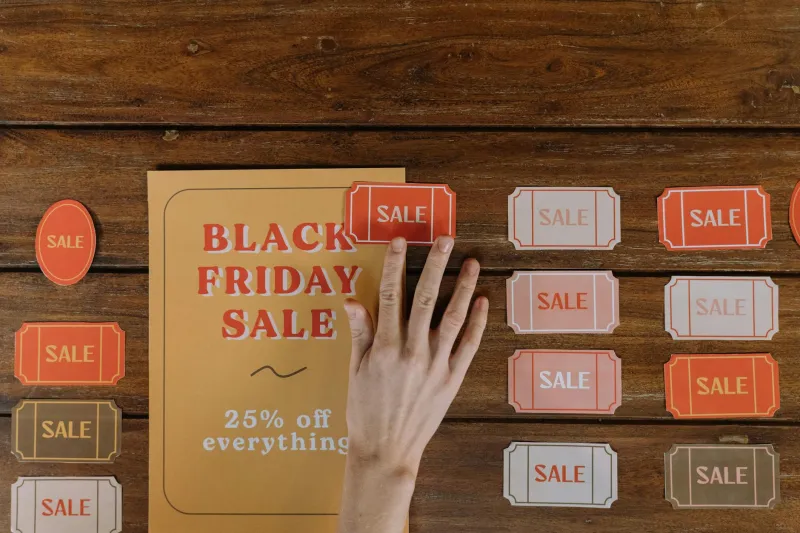
Nowhere is Britain's bargain obsession more visible than in our wholehearted adoption of Black Friday—an American import that we've embraced with the enthusiasm of recent converts to a new religion. Despite having no Thanksgiving to recover from, Brits now queue in the pre-dawn darkness, ready to battle for discounted televisions they weren't planning to buy.
The irony is delicious: a nation that prides itself on queuing orderly has adopted the most chaotic shopping tradition imaginable. Videos of British shoppers wrestling over marked-down electronics have become annual entertainment, a reminder that scratch the surface of politeness and you'll find a bargain hunter ready to rumble.
Retail data shows that 67% of Black Friday purchases in the UK are impulse buys, items people hadn't considered owning until the discount made them "essential." We've created a shopping holiday dedicated to buying things we don't need because they're cheaper than we won't pay for them.
The False Economy of Feeling Rich
Perhaps the most insidious aspect of Britain's discount obsession is how it makes us feel wealthy while making us poorer. Every bargain purchase comes with a hit of financial superiority—we're savvy, we're smart, we've beaten the system. The fact that our bank balance disagrees is irrelevant; we feel rich because we're spending less than we theoretically could have.
This creates what psychologists call "discount dopamine"—the chemical reward we get from securing a deal. It's the same neurological response gamblers experience when they win, which explains why bargain hunting can become genuinely addictive. We're not shopping for items; we're shopping for the high of getting a good deal.
Take Margaret from Leeds, whose wardrobe contains seventeen discounted dresses she's never worn. "But they were such good deals," she insists, apparently unaware that seventeen unworn dresses represent the opposite of good value regardless of their original prices. "I saved hundreds of pounds!" she adds, seemingly oblivious to the hundreds of pounds she actually spent.
The Outlet Village Phenomenon
Britain's countryside is now dotted with outlet villages—retail theme parks dedicated to the illusion of luxury at accessible prices. These carefully curated environments are designed to make us feel like we're getting insider access to high-end goods, when in reality we're often buying items made specifically for outlets at artificially inflated "original" prices.
The outlet village experience is pure theatre. The brands are recognisable, the discounts are prominent, and the atmosphere suggests exclusive access to insider deals. Never mind that the "designer" item was probably manufactured specifically for the outlet at a quality level that justifies the discounted price. What matters is the feeling of luxury acquisition at a fraction of the cost.
The Subscription Sale Trap
The modern evolution of Britain's bargain obsession has found new expression in subscription services and membership deals. We sign up for Amazon Prime to "save money" on shipping, join Costco to "save money" on bulk purchases, and subscribe to multiple streaming services because each one individually represents "great value."
The mathematics here are particularly twisted. We pay annual fees to access discounts on purchases we might not otherwise make, creating a psychological pressure to shop enough to "justify" our membership. It's the retail equivalent of a gym membership, except instead of feeling guilty about not exercising, we feel guilty about not buying enough discounted items.
The Social Media Sale Amplification
Instagram and Facebook have turbocharged Britain's bargain culture by making deal-hunting a social activity. Facebook groups dedicated to sharing discounts and bargains have millions of members, creating communities built around the shared pursuit of paying less for things.
These platforms have transformed bargain hunting from a personal pursuit into a competitive sport. Members compete to find the best deals, share their "hauls," and celebrate their savings with the enthusiasm of sports fans. The social validation of finding a good deal now rivals the satisfaction of the purchase itself.
The Psychology of Scarcity and Urgency
Retailers have weaponised British bargain psychology through artificial scarcity and time-limited offers. "Limited time only," "while stocks last," and "final few hours" create urgency that overrides rational decision-making. We buy not because we want something, but because we might not be able to buy it tomorrow at the same price.
The countdown timer has become the most powerful tool in retail psychology, creating a sense of impending loss that makes immediate purchase feel necessary rather than optional. We're not buying products; we're buying peace of mind that we haven't missed out on a deal.
The Uncomfortable Truth
Here's what we don't like to acknowledge: most of our bargain purchases would fail a simple test. If the item appeared tomorrow at the sale price without any mention of an original higher price, would we still buy it? The honest answer, for most discount purchases, is probably not.
We're not really buying products—we're buying the story of having outsmarted the retail system. The discount becomes more valuable than the item itself, which explains why we can feel satisfied with purchases we never actually use.
Recalibrating Our Relationship with Value
Perhaps it's time to acknowledge that our bargain obsession has fundamentally rewired how we think about value, need, and financial responsibility. We've created a culture where the percentage saved matters more than the pounds spent, where the thrill of the deal outweighs the utility of the purchase.
The most expensive items in our homes might not be the ones we paid the most for—they might be the bargains we couldn't resist. After all, what's more costly: the full-price item you love and use every day, or the half-price item that sits unused in your cupboard?
Maybe the real bargain isn't in the discount—it's in learning to recognise the difference between a good deal and a deal that's simply good at separating us from our money. But then again, where's the fun in that?